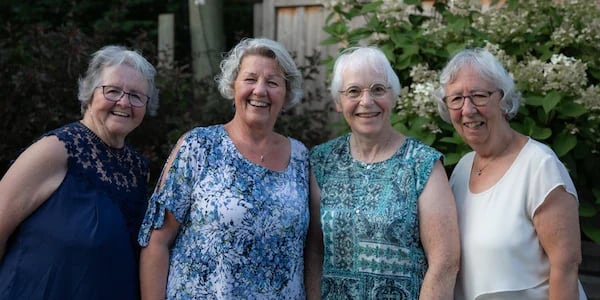
While many seniors live alone, these four chose a shared home that combines companionship and independence.
On a quiet, tree-lined Ottawa street, four women have created a communal home designed for how they want to grow older.
The close friends, all single and retired professionals, call themselves the ‘soul sisters’: Mary Alice Henry and Dona Bowers were physicians, Kathy Crowe was a nurse, and Norah McMahon was a high school teacher.
In their custom-built house, each woman has her own fully self-contained private unit with a kitchen and bathroom, around 800 to 900 square feet each. They also share other indoor spaces, like a bigger kitchen, dining room, living room, guest room, craft room and garden.
The four, who range in age from 74 to 81, met through a church choir. They were all living on their own, and back in 2017 started to talk through the practicalities of co-housing, from finances to personal values. They moved in together in December 2022, and each have a 25 per cent ownership in the property.
The goal was to have housing that allowed them to live on their own, alongside built-in support and companionship. “It’s nice having company, and the independence that we all really cherish,” Ms. Crowe says.
Across Canada, city planners and policymakers are looking at what age-friendly environments entail, from accessible spaces and transportation, to social inclusion, to home modifications and proximity to community services that enable people to age in place.
All are central to aging well – and so are our social networks, says Dr. Meghan Joy, an associate professor of political science at Concordia University who studies aging and public policy. “A sense of familiarity, closeness and care is crucial.”
According to a 2021 report form Statistics Canada, 28 per cent of Canadians aged 75 or older live alone. That doesn’t necessarily mean they lack social connections. Still, those experiencing social isolation face associated risks like a reduced sense of well-being, and poor general health and mental health, notes the Federal/Provincial/Territorial Ministers Responsible for Seniors Forum.
“It’s kind of a vicious circle,” Ms. Crowe says. “The older a person becomes, and the less active they become, the more isolated they become.”
The soul sisters have a model that that brings camaraderie right to the door. “We can see each other as much – or as little – as we want,” Ms. Crowe says.
The arrangement also offers reassurance about the future. “At this stage in my life, I don’t have to wake up in the morning and wonder how I’ll downsize and where I’ll go,” says Ms. McMahon.
The quartet carve out time for shared meals every week, and have regular meetings where they make collective decisions about finances, maintenance and their shared spaces. Beyond that, daily life remains flexible. But they know they can lean on each other. When Ms. McMahon’s cat, Mac, became seriously ill, her housemates provided emotional support, and one drove to the vet so Ms. McMahon didn’t have to drive herself and put Mac in a cage.
Through her research, Dr. Joy has heard a strong desire for different housing options for aging, especially as traditional family structures change. She notes that not everyone has a lifelong partner. And while other communal housing options for seniors exist, whether for independent or assisted living, not everyone wants or needs to be in a formal retirement community. That’s why Dr. Joy is enthusiastic about innovative models involving friends.
The architect behind the soul sisters’ building, Rosaline Hill, hopes that co-housing becomes a staple option within the housing market, whether a person is aging or not.
“I believe we’re not fully human unless we are experiencing life together,” Ms. Hill says.
For the soul sisters, that belief isn’t abstract. Ms. McMahon says her generation grew up with many communal settings and opportunities for bonds that she feels have faded. By living with friends, she says, “We are reclaiming that value of being connected.”
VIA: Globe & Mail, Canada
From left to right: Mary Alice Henry, Dona Bowers, Kathy Crowe and Norah McMahon. Supplied/Aude Urbancic