What to Look for in Cambridge Condos for Aging in Place
July 16, 2026
July 16, 2026
Wondering whether a Cambridge condo can truly support you or a loved one for the long term? It can, but the right fit usually comes down to details that are easy to miss on a quick showing. If you are planning a move with safety, comfort, and independence in mind, this guide will help you spot the condo features that make aging in place easier in Cambridge. Let’s dive in.
Aging in place means staying safely and independently in your home and community as your needs change. That idea is especially relevant in Cambridge, where many daily needs are close by and the city says it is relatively easy to live or work without driving.
Cambridge also has a meaningful condo market. City data show that 27.6% of dwelling units are condominiums, and 34.1% of dwelling units are in properties with more than 100 units. That gives you real options, but it also means not every building will offer the same level of ease, access, or support.
When you tour a condo, start with the path into the home. One of the most important age-friendly features is a step-free or zero-step entry from the sidewalk, garage, or elevator lobby.
That sounds simple, but it can shape daily life in a big way. A beautiful unit is less practical if you have to manage stairs at the front door, a raised threshold, or a long route through heavy doors.
A true zero-step path can make the home easier to use now and later. If there is no zero-step exterior doorway, a garage-side entry or ramp may still help, but the easiest setup is a direct route without steps.
In a Cambridge condo building, check the entire trip, not just the front entrance. You want to know how easy it is to move from the street or parking area to the lobby, elevator, and unit.
Many older adults prefer a single-floor living pattern because it cuts down on daily physical strain. Cambridge has long recognized that elevator-served residential buildings can appeal to older households for this reason.
If the condo is on one level and the building elevator serves the spaces you actually use, daily life often becomes much simpler. That includes parking, mail, trash, and any shared amenities.
Light switches, outlets, and thermostats should be easy to reach and use. In newer multifamily buildings, accessible controls are part of the accessibility baseline described by HUD for covered housing first occupied after March 13, 1991.
This is one of those small details that can make a big difference over time. Good access should feel natural and convenient, not like a workaround.
Bathrooms deserve extra attention because wet surfaces increase fall risk. If you are comparing condos for long-term use, the bathroom setup should be one of your top screening points.
AARP recommends properly anchored grab bars near the toilet and in the tub or shower area. In newer covered multifamily housing, reinforced bathroom walls can also matter because they may allow grab bars to be added later more easily.
Even if a condo does not already have every safety feature installed, it may still be a strong option if it can adapt well. Reinforced bathroom walls and a layout that could support a walk-in shower are practical things to ask about.
This is where future planning helps. You do not need to wait for an urgent need before thinking through what changes would be realistic.
A kitchen should be easy to move through, easy to see in, and easy to use without a lot of reaching or carrying. AARP notes that kitchens are common places for fires, spills, slips, trips, and drops, so layout and visibility matter.
As you tour, notice whether the kitchen feels open and manageable. A kitchen that supports safe, comfortable daily routines is often more valuable than one with flashy finishes.
Some of the most useful aging-in-place features are not glamorous. They simply make day-to-day life less tiring and less risky.
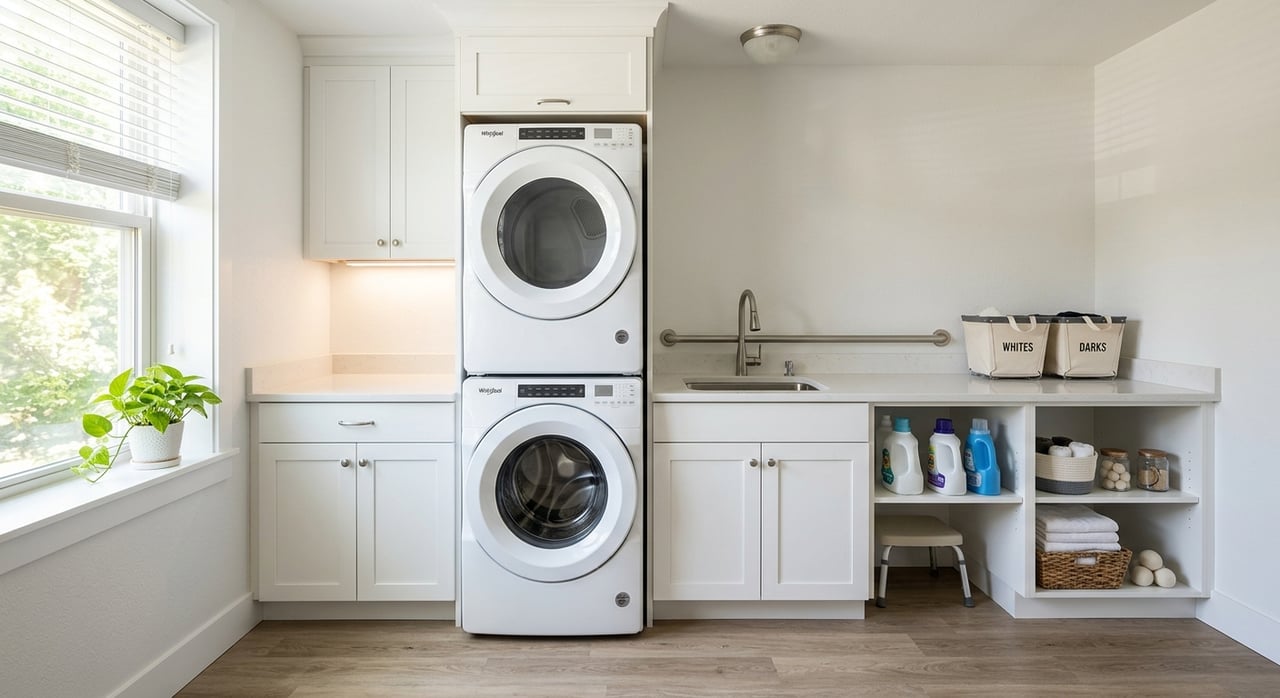
Laundry is much easier when it is inside the unit or close to where clothes are put on and taken off. When the washer and dryer are far away, laundry becomes a carrying and travel task instead of a simple chore.
For many buyers, this feature quickly moves from nice-to-have to essential. It is worth treating as a real quality-of-life factor during your search.
Hallways, stair landings, and entrances should be well lit and easy to navigate. Proper lighting, handrails, and the absence of clutter can make these spaces safer and more comfortable to use.
The same idea applies to closets and storage areas. Organized storage can reduce the chance of items falling or creating obstacles.
A condo may look perfect inside but still create daily frustration if the building itself is hard to use. In Cambridge, building-level features are a major part of aging in place.
An elevator is most helpful when it connects all the levels you actually need. That means more than just the lobby and your floor.
Check whether the elevator serves parking, mail, trash, and any community or outdoor spaces you expect to use. If one of those spaces still requires stairs, the building may be less practical than it first appears.
One of the advantages of condo living is that some upkeep is shared. A strong homeowners association or responsive management team can help with repairs, elevator issues, package access, and winter maintenance.
This matters because aging in place is not just about the unit. It is also about whether the building can help reduce the everyday strain of property care.
If you drive, or if family and friends visit often, parking is worth a close look. A well-lit, uncluttered, easy-to-reach garage or reserved parking space is usually more useful than a distant or awkward setup.
The same goes for the route from parking to the unit. A convenient parking arrangement can support independence and make visits easier.
In Cambridge, aging in place is not only about what is inside the condo. It is also about what is nearby.
The city says many services are close at hand, and a quarter of residents use transit to commute. That local setup can be especially helpful if driving becomes less appealing over time.
When groceries, pharmacies, medical care, and everyday errands are nearby, daily routines can feel much more manageable. This can reduce dependence on a car and make it easier to stay connected to your community.
That is why location should be part of your condo checklist, not an afterthought. A workable building in the wrong spot may still be a poor long-term fit.
Cambridge also offers age-oriented transportation support through the Council on Aging. The city provides an accessible shuttle from residents’ homes to the Cambridge Senior Center, Door2Door rides to medical appointments and grocery stores, and a taxi discount program for older or disabled residents.
The shuttle currently serves Central Square and East Cambridge on Mondays and Wednesdays, and North and West Cambridge on Tuesdays and Thursdays. For some households, access to these programs can become an important part of staying independent.
The Cambridge Senior Center at 806 Massachusetts Ave. provides meals, social and support programming, computer access, and tech help for residents age 60 and older. The North Cambridge Senior Center at 2050 Massachusetts Ave. offers another nearby option.
If you are comparing Cambridge condos, closeness to these resources can be a meaningful quality-of-life advantage. It is not just about convenience. It is about having support close to home.
When you are weighing options, it helps to use the same checklist for every building. That makes comparisons clearer and keeps important details from slipping through the cracks.
Aging-in-place decisions are rarely just about square footage or finishes. You are weighing layout, access, building function, neighborhood convenience, and how the home may serve you over time.
That is where a calm, step-by-step approach can make a real difference. Whether you are rightsizing for yourself or helping a parent plan a safer next chapter, it helps to have someone who understands both the housing details and the transition itself.
If you are exploring Cambridge condos with aging in place in mind, Elder Moves Real Estate can help you sort through the options with care, clarity, and a concierge approach that keeps the process manageable.
We deliver exceptional results with humor, sincerity, and good business practices. Our dynamic duo understands that the process of moving involves more than just buying or selling a home; it involves orchestrating a seamless logistical and compassionate experience for seniors. Contact us today to find out how we can be of assistance to you!